
Families and Activities Directors ask the same question: What can we do this week that feels meaningful—without a ton of prep? Below are five low-effort, high-connection ideas you can run at home or in senior living. Each includes timing, materials, and prompts.
1) Three-Object Story
Why it works: concrete objects unlock specific memories (a common approach in reminiscence therapy; see Xu 2023 and Zhong 2023).
Time: 15–20 minutes · Materials: 3 small objects per person (or from a shared bin)
- Pick any three objects (e.g., a house key, recipe card, coin).
- Tell one short story each: “This reminds me of…”
- Switch objects and repeat.
Prompts:
- Who first gave you something like this?
- Where did you use it most?
- What stayed the same about you since then?
Tip: record one story on a phone as a 30–60s keepsake clip.
2) Music & Moments
Why it works: music reliably evokes autobiographical memories—even in Alzheimer’s (see Baird 2020 and Kaiser 2023).
Time: 15 minutes · Materials: a short playlist (3–5 songs)
How: play ~60–90 seconds of a song, then pause and ask:
- Where does this take you?
- Who were you with?
- What did life feel like that year?
Optional: write down one lyric and why it still matters.
3) Recipe Recall
Why it works: smells/tastes are powerful memory cues (the “Proust effect”)—see Chu & Downes 2000, Hackländer 2019, Herz 2016.
Time: 20–30 minutes · Materials: one familiar snack or a few spices to smell
How: bring a simple food to the table (or pass spices). Share: who taught you the dish, when you made it, and who loved it most.
Prompts:
- What did you do while it baked/simmered?
- What went wrong the first time you tried?
- Who should learn this next?
4) Postcard to the Past
Why it works: short writing reduces pressure and focuses on one moment.
Time: 15 minutes · Materials: index cards or postcards
How: write a postcard to your earlier self or someone you miss. Start with: “I’m writing from…” (place/time). Read aloud if comfortable; save cards in a keepsake box.
5) Photo in a Sentence
Why it works: single images trigger specific detail and social sharing; photo-based reminiscence supports engagement—see Jiang 2021 and Tan 2023.
Time: 10–15 minutes · Materials: one photo each (printed or on phone)
How: each person shares one sentence per round:
- This was the day…
- The person off camera was…
- Right after this, we…
Do three rounds to build a small collage of vivid moments.
Make it smooth (for staff & families)
- Visible prompts: keep the current question on-screen or on cards.
- Short takes: rotate speakers every 2–3 minutes.
- Good light & quiet: face a window; turn off TVs/AC.
- One story = a win: stop while energy is still good.
Save something from today
If a moment feels special, record a 30–60s clip or jot a few notes. Over time, these become an easy keepsake video or a small family archive.
For practical activity ideas and caregiver guidance, see the National Institute on Aging: Adapting Activities · Care for Yourself
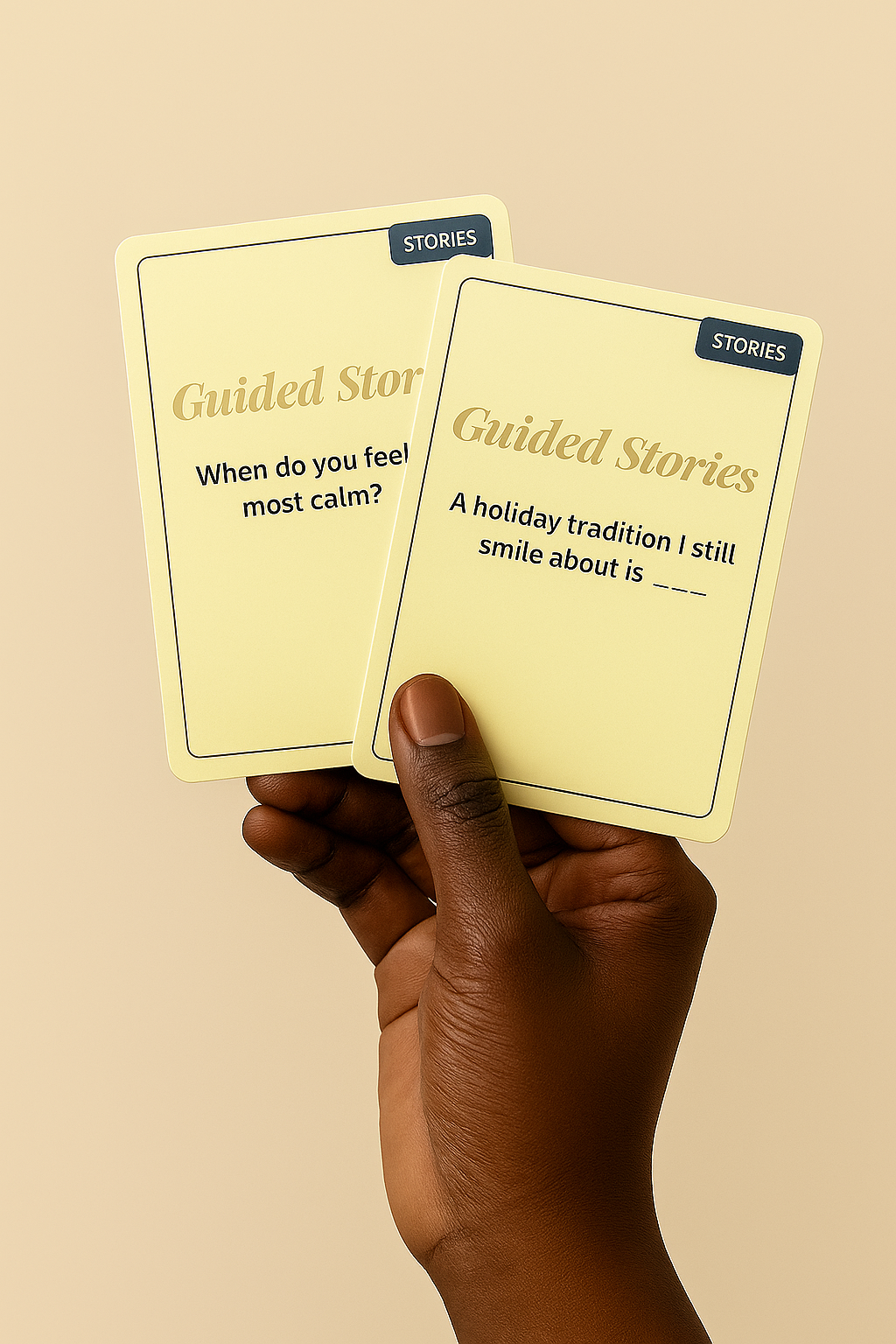
Need on-screen prompts? Try Guided Stories by AfterLyfe • Download Free Prompts
Further reading & sources
- Reminiscence therapy overviews: Xu 2023, Shin 2023, Zhong 2023.
- Music-evoked autobiographical memory: Baird 2020, Kaiser 2023, Baird 2018.
- Olfactory/taste cues (“Proust effect”): Chu & Downes 2000, Herz 2002, Herz 2016.
- Photo reminiscence: Jiang 2021, Tan 2023.